
Only if the lamp shines straight into your face. If you are treating your back, knee or shoulder, there is no need, and you can just keep your eyes open. Almost every piece of advice leaves this out, so people sit through half a session with their eyes shut while the lamp is not even shining into them.
- Face, (neck or chest,) lamp right in front of your eyes: eyes closed, or goggles on.
- Back, legs, joints, lamp out of your line of sight: eyes open. You can read or look at your phone, or enjoy a break from your phone for once.
- Sensitive to bright light, or prone to migraine: Dim the red a little or wear protective goggles.
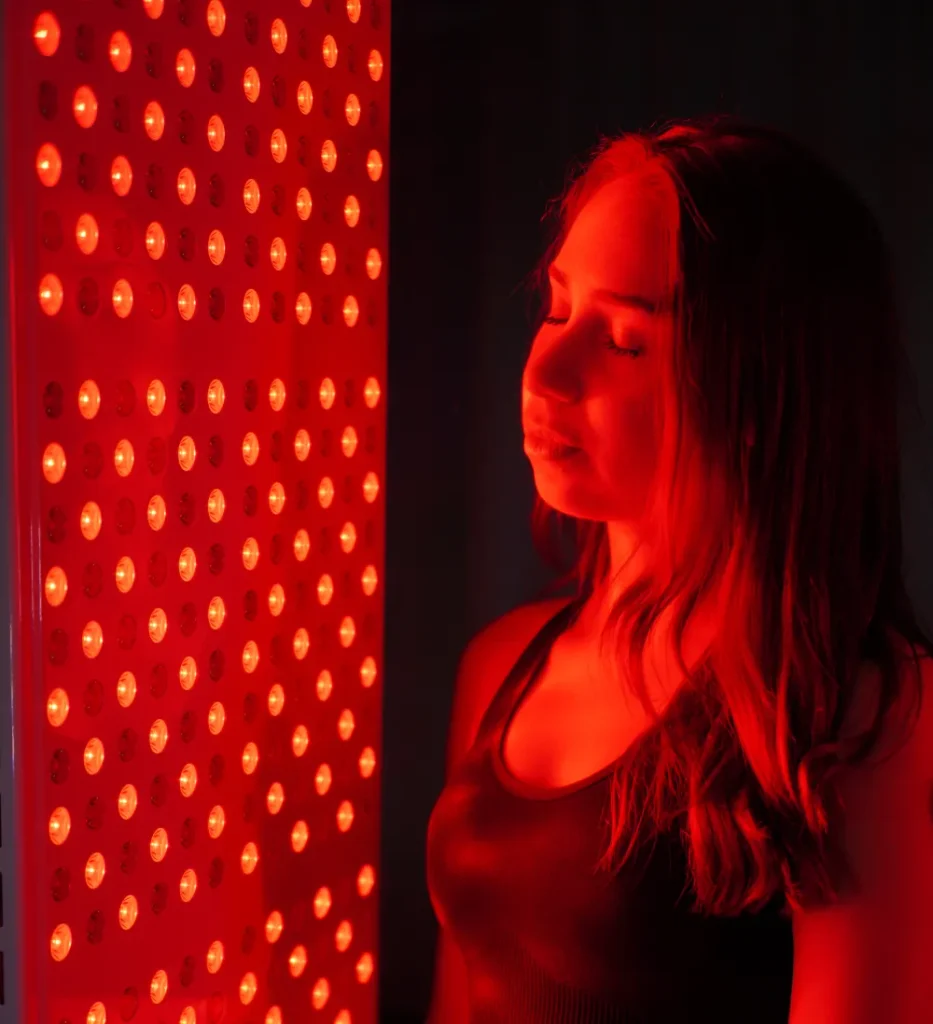
Why you close them: brightness, not damage
The reason to close your eyes is comfort. Red and near-infrared light fall outside the wavelength range where UV damage happens, but a panel at treatment distance is dazzlingly bright. You squint without meaning to, you see afterimages afterwards, and for a few minutes green or blue can look stronger than usual. Your eyelids block most of that light, and that is enough.
If you are sensitive to light, this bothers you more, and closed eyelids do not always help: you still see red light through the thin eyelid tissue. Protective goggles shut that out and prevent headaches.
What makes it confusing is that there is also research where people look into a red light with their eyes open, and it improves their colour vision. That is about a very weak lamp for three minutes, not a therapy panel. The exact difference is explained in Red light therapy eyes. For the duration and frequency of a normal session, see the FAQ.
Sources
- Shinhmar H, Hogg C, Neveu M, Jeffery G. Weeklong improved colour contrast sensitivity after single 670 nm exposures associated with enhanced mitochondrial function. Scientific Reports 2021;11:22872. The study in which people looked into the light with open eyes: 670 nm, 8 mW/cm² at the cornea, three minutes. For comparison with the intensity of a therapy panel.
- IEC 62471: the standard for photobiological safety of lamps, which classifies light sources by their risk to the eyes and skin.


