
Short answer: there is no gold standard for measuring the intensity of LED light therapy. The measuring methods and calculation rules come from the laser world, where light is coherent and monochromatic and meters from different brands give almost the same result. LED panels emit incoherent, polychromatic light over a large area. That method does not fit. On top of that fundamental problem, six practical measurement errors pile up, which typically make published figures 40 to 100 percent too high.
The fundamental problem: laser is not LED
Almost all the research red light therapy is built on was done with lasers. That is not a detail, because laser light has properties that make measuring easy.
Laser light is coherent: the waves are in step. It is monochromatic: in practice one wavelength. It comes from one point and goes in one direction. Because of that, the laser world developed a single measuring method so uniform that meters from different manufacturers give very similar results, and you can calculate in advance from the laser’s components roughly what those values will be. That is what a gold standard means: everyone measures the same thing, in the same way, with comparable results.
An LED panel is the opposite. The light is incoherent: the waves are not in step. It is polychromatic: several wavelengths at once, usually red and near-infrared mixed, each with its own spread around the peak. And it does not come from one point but from hundreds of small LEDs spread over a surface, each with its own lens and its own direction.
When LED light therapy took off, nobody came up with a new measurement standard. People grabbed the meters that were available, and those do not give the right values for this kind of light. That is still the case.
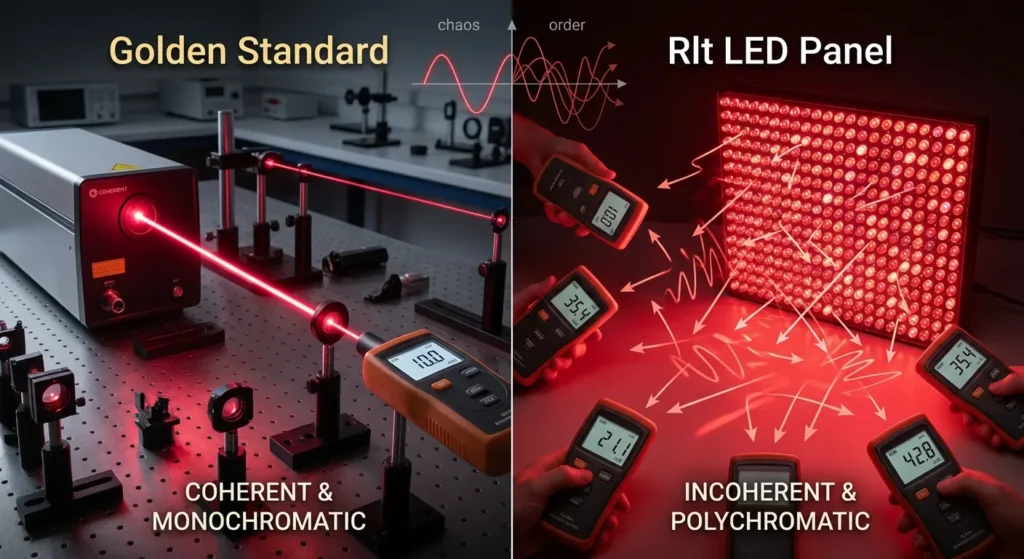
Right (RLT LED panel): a complex grid of hundreds of LEDs emits incoherent, scattered and overlapping light. Several cheap solar meters are spread around and each shows a different, random value. This shows straight away why a single number is misleading.
Why this carries through into the science
The problem does not stop with the manufacturers. Researchers working with LED panels sometimes take over those numbers, or measure themselves but do not say with which meter, or whether it is a single measurement or the average of many. So when you read a study, you often do not know how much energy was actually delivered.
On top of that, the protocols going around (so many J/cm² for this condition, so many minutes at that distance) were mostly derived from laser research and then applied to LED devices. Two kinds of light, one calculation rule, and on the LED side an intensity figure whose origin nobody can check.
The result is a race instead of a measurement: who dares put the highest number on the box? As long as nobody can check it, the highest number wins.
Even with lasers the assumption is not watertight
To be fair: even the laser side is less exact than it seems. Researchers usually calculate a laser’s intensity by dividing the power by the area of the spot. A 5 mW laser with a spot 0.2 cm across then gives 159 mW/cm². That calculation assumes the spot is a perfect circle and that the light inside it is evenly spread.
Usually neither is true. Laser beams typically show a Gaussian distribution: bright in the centre, weaker towards the edge. Others are irregular, oval or oddly shaped. That is why beam profilers exist, devices that map the actual beam profile. Research on this topic (Amaroli et al., 2021) compared a hand piece with a flat, even beam to the usual Gaussian probes and found more consistent results on mitochondrial activity with the even beam.
With an LED panel that distribution is many times more complex, because there are hundreds of sources spread over a wide surface instead of one beam. That does not make it impossible to measure, but it does make a single number as a summary of a whole panel misleading.
Measurement error 1: the wrong instrument
The solar meter
The most used instrument in this industry is a cheap solar meter, meant for sunlight and grow lights. A meter like that costs twenty to fifty euros, reads in W/m² and claims a range of 400 to 1100 nm. On paper it seems to fit.
The problem is in the sensor. Almost all of these meters use a silicon photodiode, and its sensitivity is not flat. It rises sharply towards the infrared, with a peak around 980 nm. Light at 850 nm therefore produces roughly twice as strong a response as light at 500 nm. The meter is calibrated for a broad spectrum; point it at narrow band red or near-infrared light and it structurally counts too much.
Manufacturer GembaRed checked this on its own panels and put the result of a cheap solar meter next to that of an external lab, both at 15 cm:
| Panel | Solar meter (mW/cm²) | External lab (mW/cm²) | Deviation |
|---|---|---|---|
| 660 nm only | 21 | 16 | +31% |
| With a lot of 830/850 nm | 11.3 | 6.0 | +88% |
| With a lot of 830/850 nm | 59.0 | 33 | +73% |
The pattern follows the sensitivity curve exactly. A panel with only 660 nm LEDs sits low on that curve and is off by 31 percent. Panels with lots of 830 and 850 nm LEDs sit high on the curve, and there the deviation rises to almost double.
This is not the objection of one party. There is a peer-reviewed article on it by Hadis and colleagues, titled The dark art of light measurement: accurate radiometry for low-level light therapy. In it, the authors warn that measurements with silicon photodiodes need to be interpreted carefully, precisely because spectral sensitivity shifts with wavelength and longer wavelengths are overestimated as a result.
The PAR meter
Some brands use a PAR meter. PAR stands for photosynthetically active radiation: it is a meter for growers that measures which light plants use for photosynthesis. Here too you have to convert the units to mW/cm², and here too the spectral response is not flat. So it is the same error as with the solar meter, with an extra calculation step in between.
The lux meter
A lux meter measures illuminance: how bright light is to the human eye. That is fundamentally different from power density. There is no single conversion factor between lux and W/m²: there is a different factor for every wavelength, and you can only convert if you already know the spectral makeup of the light. So a lux meter is not unsuitable for this use because it is inaccurate, but in principle.
On top of that, 850 nm is invisible to the eye. A lux meter simply does not register half of what a panel like that does.
What does work
A spectroradiometer measures the intensity at each individual wavelength and adds them up. That removes the photodiode’s sensitivity problem. It is the instrument serious measurements rely on, and it easily costs several thousand euros.
A laser power meter uses the same silicon photodiode, but it is calibrated for a specific wavelength and comes with a correction factor or a setting per wavelength. Do convert the reading: divide the power shown by the sensor area and apply the correction factor. GembaRed compared three affordable laser power meters on the same device and got 13.8, 13.1 and 12 mW/cm², where the lab reported 13 mW/cm². A solar meter on that same device gave 25 mW/cm², almost double.
Even a solar meter can become useful, provided you first correlate it with lab measurements and apply the correction factor you get from that. Without that step, the reading is a raw number that happens to have a unit.
We do have to repeat it: LED is not LASER, and these numbers are what is accepted right now because specialised labs use them. In a conversation with Sven of Ophir Spiricon Europe GmbH, a specialist in optical measuring equipment, we concluded that a completely different type of meter is probably needed, one that simply is not used anywhere.
A telling test to finish: the number of published photobiomodulation studies that use a solar meter or PAR meter to determine the dose is zero. That is because many studies take the data from the manufacturer, who does not say that their values came from this kind of meter.
Measurement error 2: a measuring distance that is not stated
Light gets weaker quickly with distance. An intensity figure without the measuring distance is therefore useless, and two numbers taken at different distances cannot be compared with each other.
The differences are large. Intensity drops visibly over just a few centimetres, and between two common use distances there can easily be a factor of difference. A number measured at 15 cm and one measured at 40 cm can come from the same panel and still paint a very different picture.
Rule of thumb: if a brand does not state the measuring distance, ask for it. Without that distance, the number cannot be placed and cannot be set next to another brand’s number.
Measurement error 3: measuring a cold lamp
LEDs give more light when they are cold. As soon as the LEDs and the driver warm up, output drops by something like 10 to 20 percent. If you measure right after switching on, you record a value the device never reaches during a ten to twenty minute session. A measurement should be taken once the device is in thermal equilibrium, usually after a quarter of an hour.
It is not only the amount of light that changes as it warms up. The wavelength peak can also shift during a session, which means a panel that peaks neatly at 660 nm when cold can end up somewhere else when warm.
Measurement error 4: one number for a whole surface
A panel does not shine equally brightly everywhere. There is a hotspot in the centre; towards the edges the intensity drops off. One measurement in the centre is therefore the best point of the product, not what lands on a body.
How much it varies is shown by an iso-irradiance plot: a kind of contour map, but for light intensity. An analysis like that of a panel at 15 cm gave the following picture:
| Position | Intensity |
|---|---|
| Centre of the panel (maximum) | 47 mW/cm² |
| Average in the central zone | 40 mW/cm² |
| Edge of the panel | 20 mW/cm² |
| Just outside the panel | 10 mW/cm² |
| A bit further out | 5 mW/cm² |
| Outer limit | 1 mW/cm² |
So at the edge of the panel the intensity is sometimes already more than halved compared with the centre. Anyone who only publishes the maximum is publishing a value that does not reach most of your body.
So measurements should be taken at several points, and the result should be published as at least two numbers: the surface average and the edge value, or a uniformity ratio. Measurement grids range from a five point cross pattern to a 49 point grid of 7 by 7 points; the finer the grid, the more honest the picture.
Measurement error 5: lens angle sold as beam angle
This point directly affects the stated treatment area, and it is rarely mentioned.
The lens angle is the angle of the small lens over a single LED: 30, 60 or 90 degrees. The beam angle of the whole panel is something else: it follows from all the LEDs together, the spacing between them, their lenses and the way all that light comes together. The two are not interchangeable and can be far apart. On panels with 60 degree lenses, an external lab measured a beam angle for the whole panel of only 20 degrees.
If you use the lens angle to calculate the coverage area, you end up with far too large an area. That is how claims arise in which a one metre tall panel at 45 cm would light an area of almost two metres, with the stated intensity everywhere across it. Buyers then find they need extra panels for the coverage one panel promised.
Measurement error 6: wattage instead of light
The total power of the installed LEDs, or the draw from the wall socket, is not a light measurement. It tells you how much electricity goes in, not how much usable light comes out. The difference depends on efficiency, optics and heat management.
Also watch the difference between an LED’s nominal wattage and the power it is actually driven at. An LED sold as 5 watts is often driven at a fraction of that in a panel, or it would get too hot. Seen that way, a panel that gives off a lot of heat is not a sign of strength but of waste.
Irradiance is also not the same as total optical power. Irradiance tells you how much light falls on one square centimetre; total radiant power tells you how much light the device produces in all directions, measured in an integrating sphere. A small device with a narrow beam can reach a high irradiance and still deliver little total power.
The errors add up
These choices are not mutually exclusive. A brand can measure with a solar meter, without stating the distance, on a cold lamp, in the centre, and present the result with a coverage area based on the lens angle. Each of those steps is worth tens of percent on its own.
| Measurement choice | Effect on the number | What it should be |
|---|---|---|
| Solar meter or PAR meter | Strongly inflating, especially with near-infrared; up to +88% measured | Spectroradiometer, or a meter calibrated per wavelength with a correction factor |
| Lux meter | Unusable in principle; 850 nm is not registered | Radiometric measurement, not photometric |
| Measuring distance not stated | Makes the number impossible to compare with another brand’s | Always publish the measuring distance with the number |
| Cold lamp | +10 to 20%, plus a possible wavelength shift | At least 15 minutes of warm-up to thermal equilibrium |
| Only the hotspot | Edge is roughly half of the centre | Multi-point grid; publish both the average and the edge value |
| Lens angle as beam angle | Coverage area heavily overestimated | Have the beam angle of the whole panel measured |
| Wattage as a measure of light | Says nothing about optical output | Measure total radiant power in an integrating sphere |
What you can check yourself
Without a lab you can still spot the obvious cases.
- Evenness with the naked eye. Switch the panel on in a dark room and look from a few metres away. Count dead or weaker LEDs and look for areas that are darker overall. Colour differences between the red LEDs point to poor LED selection.
- Make infrared visible with your phone camera. Most phone cameras are sensitive up to about 1000 nm, so 850 nm LEDs show up on your screen as purple or white dots even though you cannot see them with the naked eye. That way you can check whether the infrared LEDs are actually on. Some newer phones have a stronger infrared filter, so try a second phone if needed.
- Spot flicker with video. Point your camera at the panel and look at the screen instead of the lamp. Rolling horizontal bands point to flicker from a cheap driver. Slow motion makes it clearer.
- Colour of the red LEDs. Orange red points to a lower wavelength than advertised; deep red is what you expect at 660 nm. Rough, but enough to pick out LEDs that are clearly off.
- A cheap meter as a comparison with itself. The very instrument this article criticises can be used sensibly as long as you ignore the absolute value. Measure at a fixed distance, record that as your baseline, and repeat every six months. If the value drops a lot, your LEDs are degrading. The calibration problem then cancels itself out.
In short
The core problem is not that people measure badly, but that there is no agreement on how to measure. The laser world has that agreement; the LED world never made one and meanwhile applies the laser world’s calculation rules to light that is fundamentally different. As long as that stays the case, the numbers on the box cannot be compared with each other, and the protocols built on them are no stronger than their weakest assumption.
Scientific sources
- Hadis et al., The dark art of light measurement: accurate radiometry for low-level light therapy, Lasers in Medical Science
- Amaroli et al., Improving Consistency of Photobiomodulation Therapy: A Novel Flat-Top Beam Hand-Piece versus Standard Gaussian Probes on Mitochondrial Activity, International Journal of Molecular Sciences, 2021
- Accredited labs that carry out this type of measurement: LightLab International, Laser Compliance, UL and Intertek


