
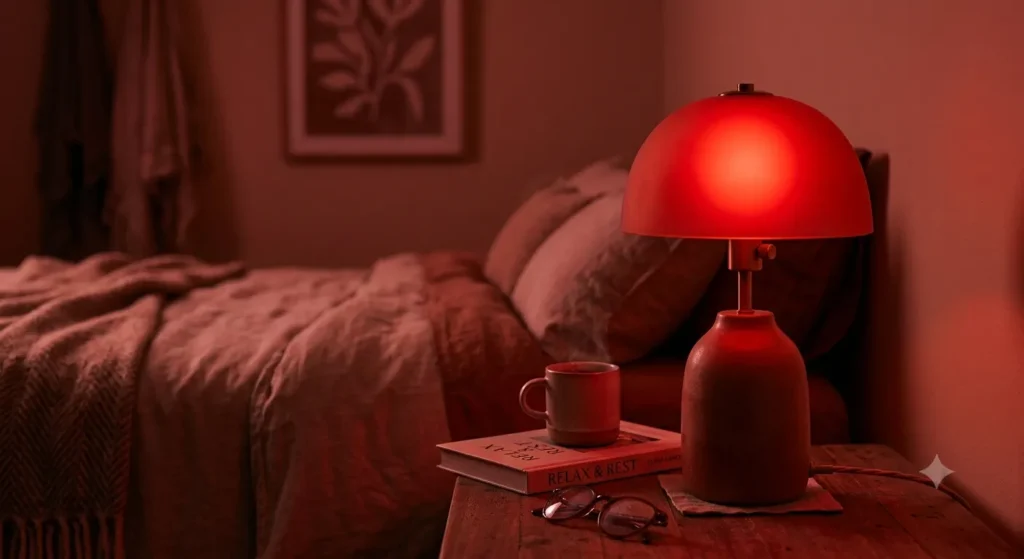
Red light in a bedroom
Introduction
Looking for an anti-blue red light lamp? More and more people are consciously choosing red light in their homes instead of standard white or blue LED light — especially in the evenings and at night. The reason is simple: blue light suppresses the production of melatonin, the hormone that prepares your body for sleep. Red light does this much less, making it a more pleasant choice for evening lighting, night lights, and bedrooms. In this guide, we explain what to look for when choosing an anti-blue red light lamp, and which format (E27, E14, GU10, or a rechargeable battery-powered lamp) best suits your situation.
Why an anti-blue red light lamp?
White and blue light — including the light from many standard LED bulbs — contains a large proportion of blue wavelengths. This is fine during the day (it keeps you alert), but in the evening hours, it can signal to your body that it is still daytime, which can make falling asleep more difficult. An anti-blue red light lamp contains little to no blue wavelengths and is therefore often used for:
- Night lights for children and adults
- Lighting during nightly bathroom visits, without startling yourself awake
- Atmospheric lighting in the bedroom during evening hours
- Reading lights for use just before bedtime
What should you look for when purchasing?
When buying a red light lamp, it comes down to five practical points:
1. Truly anti-blue, not just “red in color”
Not every red lamp is actually free of blue wavelengths. Some cheap red LEDs still contain a significant blue component, masked by a red color filter. Look for products that explicitly state they emit no blue wavelengths, not just that they are “red.”
2. The correct socket type
This determines whether the lamp fits into your existing fixture:
- E27 — the most common large socket, suitable for standard lamps, table lamps, and some night lights.
- E14 — the smaller socket, often used in smaller lampshades, wall lights, and mood lighting.
- GU10 — recessed spotlight fitting, popular for ceiling spots and recessed lighting in bedrooms or hallways.
Always check which socket your existing lamp or fixture has before ordering — this is the most common mistake in online purchases.
3. Battery-powered lamps (rechargeable, without socket)
In addition to screw-in bulbs, there are also separate, rechargeable battery-powered lights that do not need to go into an existing fixture, such as the Wall-E automatic battery night light. These are useful for:
- Flexible use without fixed installation (for example, next to the bed or on a nightstand)
- Use while traveling or camping
- Automatic night lights with motion sensors that work without a power outlet
For battery models, pay attention to the battery life (how long a full charge lasts) and whether the lamp switches on/off automatically via a sensor or must be operated manually.
4. Brightness (lumens) and dimmability
For a night light, you usually want a low light level — red light that is too bright can still be disruptive in the dark. Look at the number of lumens and, if possible, whether the lamp is dimmable. A dimmable lamp provides flexibility: brighter for practical use, softer for pure atmosphere or as a night light.
5. Lifespan and energy consumption
LED lamps (including the red/anti-blue variants) generally last for years and consume little power. When comparing, pay attention to the stated wattage and the expected lifespan in burning hours.
Which type suits your situation?
Use the overview below to find the right red light lamp for your situation at a glance:
| Situation | Recommended type |
|---|---|
| Existing table lamp/night light with large socket | E27 |
| Small mood lamp or wall light | E14 |
| Recessed spotlight in ceiling or hallway | GU10 |
| No fixed socket, flexible on nightstand or on the go | Battery-powered light |
| Children’s room, bathroom, and hallways, automatic at night | Battery-powered light with motion sensor |
Frequently Asked Questions
Is red light at night really better than white light? Blue light is demonstrably the most suppressive for melatonin production; red light contains hardly any of this wavelength and is therefore more often recommended for evening and night use. Also read our explanation in Does red light therapy work? for more background.
Can I use a regular red lamp instead of a specific anti-blue lamp? You can, but be careful: a regular red incandescent bulb or cheap LED can still contain blue wavelengths under the red color filter. A lamp explicitly designed as “anti-blue” provides more certainty.
Does a battery-powered light work as well as a fixed E27/E14/GU10 lamp? In terms of light quality, this can be comparable; the difference lies mainly in flexibility (no fixed installation required) versus convenience (no charging, always on when the fixture is on).
Is this the same as blue light blocker glasses? No. An anti-blue red light lamp prevents blue light from entering the room; blue light blocker glasses filter blue light that is already present (for example, from a screen) before it reaches your eyes. Both can complement each other, but they are separate product categories.
Conclusion
When choosing an anti-blue red light lamp, it mainly comes down to three practical matters: the correct socket type for your fixture (or a battery solution if you don’t want to use a fixed socket), a truly low blue-light component, and a brightness level that suits use as a night light or mood lighting. With these choices in order, you choose a red light lamp that actually contributes to a calmer evening ritual. View the full range in the shop to see all models side by side.


