
Short answer: a solar meter is built to measure sunlight and uses a silicon photodiode whose sensitivity rises sharply towards the infrared. Point it at a red and infrared panel and it reads about twice too high. The error is also not linear, so you cannot fairly compare two panels with a meter like that either. The popular “100 mW/cm²” on a solar meter actually comes down to about 49 mW/cm².
The solar meter is the most used instrument in this industry and at the same time the least suitable. It is one of the measurement problems from the overview article on why red light therapy lamp irradiance numbers are wrong.
What a solar meter is made for
A solar meter, also called a pyranometer, is designed for one job: measuring the amount of sunlight. Solar installers use it to work out the irradiation on a roof, growers to see how much light their crops get. It costs twenty to fifty euros and reads in W/m².
Two features make it look attractive for red light therapy. The spec sheet lists a range of 400 to 1100 nm, which covers red and near-infrared light. And W/m² converts to mW/cm² with a single decimal shift, exactly the unit used in clinical studies. So on paper it seems to fit.
But the calibration is made for broadband sunlight. That is a fundamentally different kind of light from the two narrow peaks an LED panel emits.
The physics: the sensitivity curve of the silicon photodiode
Almost all solar meters use the same sensor: a silicon photodiode. A diode like that turns light into current, but not equally efficiently at every wavelength. The response is low in the blue, rises gradually through the visible range and peaks around 980 nm in the near-infrared. After that it drops off quickly.
That means the same amount of light energy gives a very different reading depending on the colour. Light at 850 nm produces roughly twice as strong a signal as light at 500 nm.
With sunlight that is not a problem, because the manufacturer calibrates the meter to the known, broad spectral makeup of the sun: the over and under sensitivity average out. An LED panel does not emit a broad spectrum but two narrow peaks right in the range where the diode is most sensitive. The averaging the calibration assumes does not happen. What is left is pure overestimation.
A laser power meter often uses exactly the same diode technology, but with a correction factor per wavelength, or a setting where you enter the wavelength. A solar meter offers no such correction, which in itself shows the instrument was never meant for this purpose.
The numbers from a controlled experiment
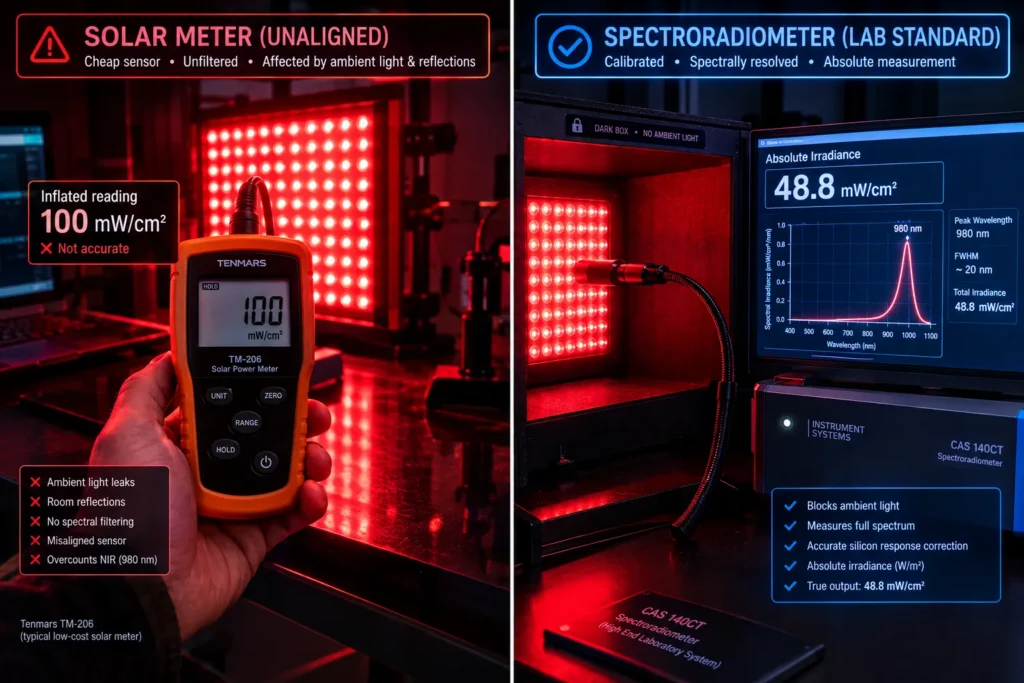
Manufacturer GembaRed did not leave it at theory. They bought a new Tenmars TM-206 (one of the cheapest and most used solar meters in this industry) and sent it to an accredited photometric lab. There the meter was set next to a professional spectroradiometer, at identical distances and conditions, across a range of intensities.
The result in one sentence: the solar meter reads about twice too high, and the error is not linear.
The clearest example is the round number that shows up everywhere in this market. A reading of 1000 W/m² on the solar meter is 100 mW/cm², exactly the value countless brands put on their product page. Corrected to the lab measurement, about 48.8 mW/cm² of that remains.
The top of the instrument’s range is telling too. The Tenmars TM-206 can show a maximum of 199.9 mW/cm², which after correction comes to about 92 mW/cm². So anyone claiming a value above 100 mW/cm² with this meter is claiming a number the instrument can never actually back up.
Why the error is not linear
If the error were a fixed factor, you could simply divide it out and comparisons would still hold. That is not the case: the best fitting correction turned out to be a polynomial, not a straight line. So the ratio between reading and reality changes with the level of the measurement.
That has an annoying consequence. Two panels measured with the same solar meter cannot be reliably compared with each other either. Claims like “twice as strong as brand X” based on solar meter readings can come entirely from that curve and say nothing about the real ratio.
Red, infrared and a stubborn misunderstanding
Because sensitivity shifts with wavelength, you need not one correction but three: for red only, for infrared only, and for the mix most panels emit. In the experiment they behaved exactly as the curve predicts: red only is off the least, infrared only the most, and the mix sits in between.
That leads to a correction of a claim you come across regularly: that infrared LEDs deliver a higher intensity than red LEDs. That is largely a measurement artefact. The infrared LEDs sit higher on the sensor’s sensitivity curve, so the meter shows a higher number, not because there is more light, but because the sensor is more sensitive to it.
What the lab itself thought
The lab that ran the comparison reached the same conclusion without being asked: the differences with their own spectroradiometer were considerable, and in their view the meters tested are fine for solar irradiation but not suitable for red and certainly not for near-infrared.
That verdict does not stand alone. There are proper standards for light measurement, set by institutes like NIST and IES, and accredited labs work with them. The problem is not that the measurement science is missing, but that this industry does not apply it.
A nice test: the number of published photobiomodulation studies that determined the dose with a solar meter or a PAR meter is zero. No researcher uses these instruments. That makes it a quick way to judge how technically sound an “expert” really is.
Even taking the reading often goes wrong
Besides the fundamental problem, there are operating mistakes that distort the number further.
- The wrong unit. These meters can also read in BTU per square foot per hour. If the meter is not set to W/m², the number cannot be compared with anything else you come across.
- The measuring range. At high intensities the meter hits its ceiling, or the decimal display has to be switched off to show higher values at all.
- Drift without recalibration. Professional measuring equipment is recalibrated every one to two years. With solar meters that does not happen; older units turn out to read systematically a bit lower than new ones. So two people with the same model can get different results.
- Stray light. The sensor does not only see the panel but also what bounces off the walls and ceiling. A lab measures in an environment where that is ruled out.
How to still use a solar meter sensibly
The meter is not worthless. It is just unsuitable for what it is being used for: publishing absolute numbers that would be comparable to lab measurements. There are three ways it is useful.
- With a correction derived from lab measurements. Correlate one specific meter model with a professional measurement across a range of intensities, and you have a correction curve that brings the reading close to reality. That curve only applies to that model, at those wavelengths.
- As a rough rule of thumb: divide by two. Not elegant, but closer to the truth than the reading itself. This also applies to advertised figures you suspect came from a solar meter.
- As a comparison with itself over time. Measure at a fixed distance, record the result as your baseline and repeat every six months with the same meter. The absolute value is wrong, but the trend is right. If the value drops a lot, the LEDs are degrading. The calibration problem cancels itself out here.
There is one more practical use: ask a brand for a photo of its measurement, with the model number of the meter used and the distance. If they publish solar meter readings, you can recalculate them yourself. You do not even need to buy a meter.
What this means for the numbers going around
The story that you need more than 100 mW/cm² for an effect has been repeated for years by brands and by people who earn from their sales. If the real intensity of almost all those devices is around half the advertised figure, then those devices do not reach that threshold themselves, while users still report results with them.
At the other end of the scale there is a safety argument. Clinical research on whole body light therapy has never used more than about 50 mW/cm² on people. A brand advertising the highest intensity on the market is implicitly advertising a value for which there is no research on safety or effectiveness.
Both sides point the same way: a higher number is not a mark of quality, and a number without a source is not a number.
Further reading
- Why red light therapy lamp irradiance numbers are wrong: the full overview of the measurement problems, including the lack of a gold standard
Scientific sources
- Hadis et al., The dark art of light measurement: accurate radiometry for low-level light therapy, Lasers in Medical Science. Explicitly warns against using silicon photodiode meters for this purpose.
- Standards for light measurement: NIST and IES


